
Case studies
AI Applied to Real-World Inspection
From railway infrastructure to rolling stock and power-grid assets, AI and computer vision can help transform visual inspection into structured digital intelligence.
Domain architecture
Selected Technology Projects
Examples of how artificial intelligence, computer vision and automated inspection can be applied to complex physical environments.
Project 01 · Railway Infrastructure · AI Inspection
OHE — AI-Powered Overhead Equipment Inspection
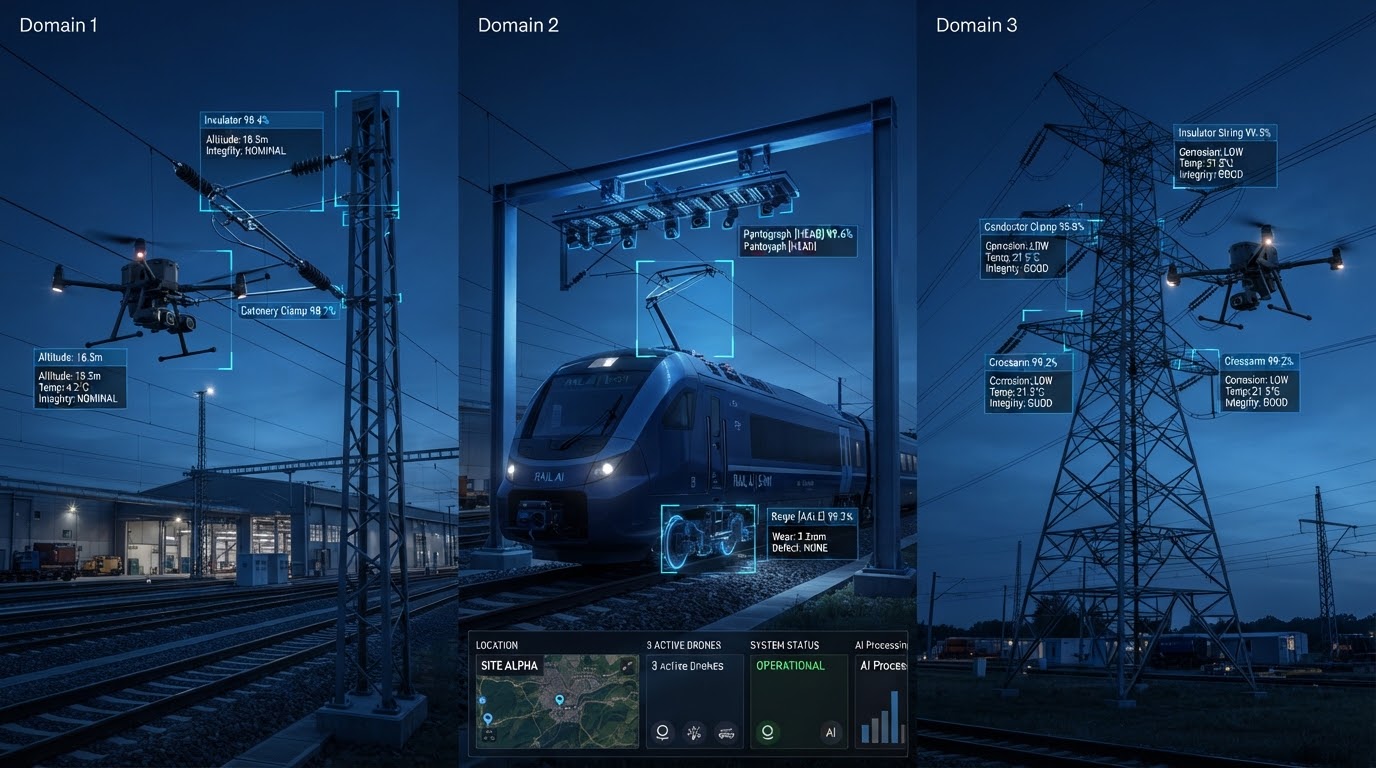
An AI-powered railway inspection workflow designed to analyze overhead equipment imagery and identify relevant components and visual conditions.
The Challenge
Scale & Structural Heterogeneity
Railway overhead equipment contains multiple components that need to be inspected across large physical environments. Manual inspection and visual review can be time-consuming and difficult to organize consistently.
Designed to augment existing enterprise rail asset management by categorizing visual inspection feeds for qualified engineering personnel.
Technical pipeline
The Technology Approach Workflow
- 01 · Capture
Autonomous Drone
Flight paths programmed parallel to catenary masts.
- 02 · Raw Sensor
RGB + Thermal
Dual optic synchronized multi-spectrum capture.
- 03 · Inference
AI / Computer Vision
Convolutional & visual transformer model passes.
- 04 · Classify
Component Detection
Localization of distinct mechanical assemblies.
- 05 · Triage
Inspection Findings
Classification of surface state and geometry.
- 06 · Artifact
GPS + Structured Report
Spatial provenance metadata bound to imagery.
Conceptual categories
Understanding OHE Components
Modular computer vision models are parameterized to recognize designated component categories within diverse electrification geometry.
- Messenger Wire
- Contact Wire
- Dropper Wire
- Registration Tube
- Tube Clamp
- Dropper Clip
- Suspension Clamp
- Parallel Groove Clamp
- Porcelain Insulator
- Polymer Insulator
- U-Bolt Pipe Clamp
- Hook Clevis
Multispectral modalities
Multiple Visual Perspectives (RGB + Thermal)
RGB imagery provides visual information for component inspection, while thermal imagery provides an additional inspection modality for applications where thermal information is relevant.
End-to-end auditability
From Image to Inspection Finding
The inspection workflow is designed to connect AI findings with image evidence, location metadata and structured reporting.
- Image
- Detection
- Finding
- Location
- Evidence
- Report
Project 02 · Railway · Computer Vision Inspection
Rolling Stock — High-Speed Vision Inspection
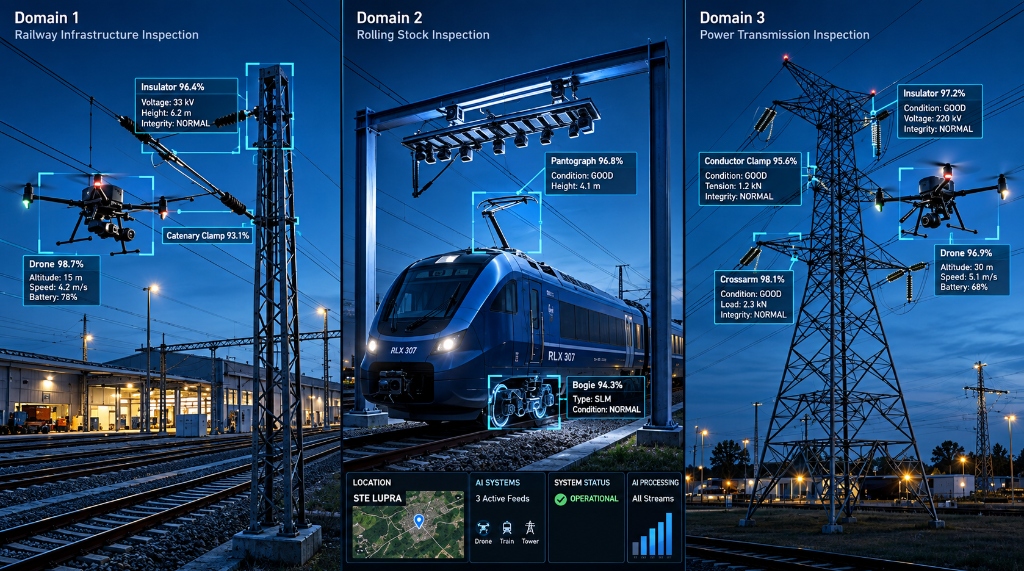
High-speed cameras are used to capture images of railway rolling stock as it passes through an inspection environment. Computer vision can then analyze the captured imagery to identify components and potential visual faults.
Operational context
The Inspection Challenge
Railway rolling stock contains many components that need to be inspected. Capturing and analyzing large volumes of imagery requires a consistent and scalable visual inspection approach.
Designed to highlight images for engineer review. People make the decisions.
Ingestion pipeline
High-Speed Visual Inspection Workflow
- 01 · Inbound
Rolling Stock Inbound
Train passes calibrated lineside track portal.
- 02 · Capture
High-Speed Cameras
Multiview strobe illumination capture sequence.
- 03 · Analyze
Computer Vision
Image preprocessing and component localization.
Inspection output architecture
Organized Inspection Information
Computer vision can analyze captured images to identify relevant components and visual conditions, helping organize inspection information for further review.
- Image
- AI analysis
- Component
- Visual condition
- Evidence
Project 03 · Power Infrastructure · Drone Inspection
Power Grid — Drone-Based Infrastructure Inspection
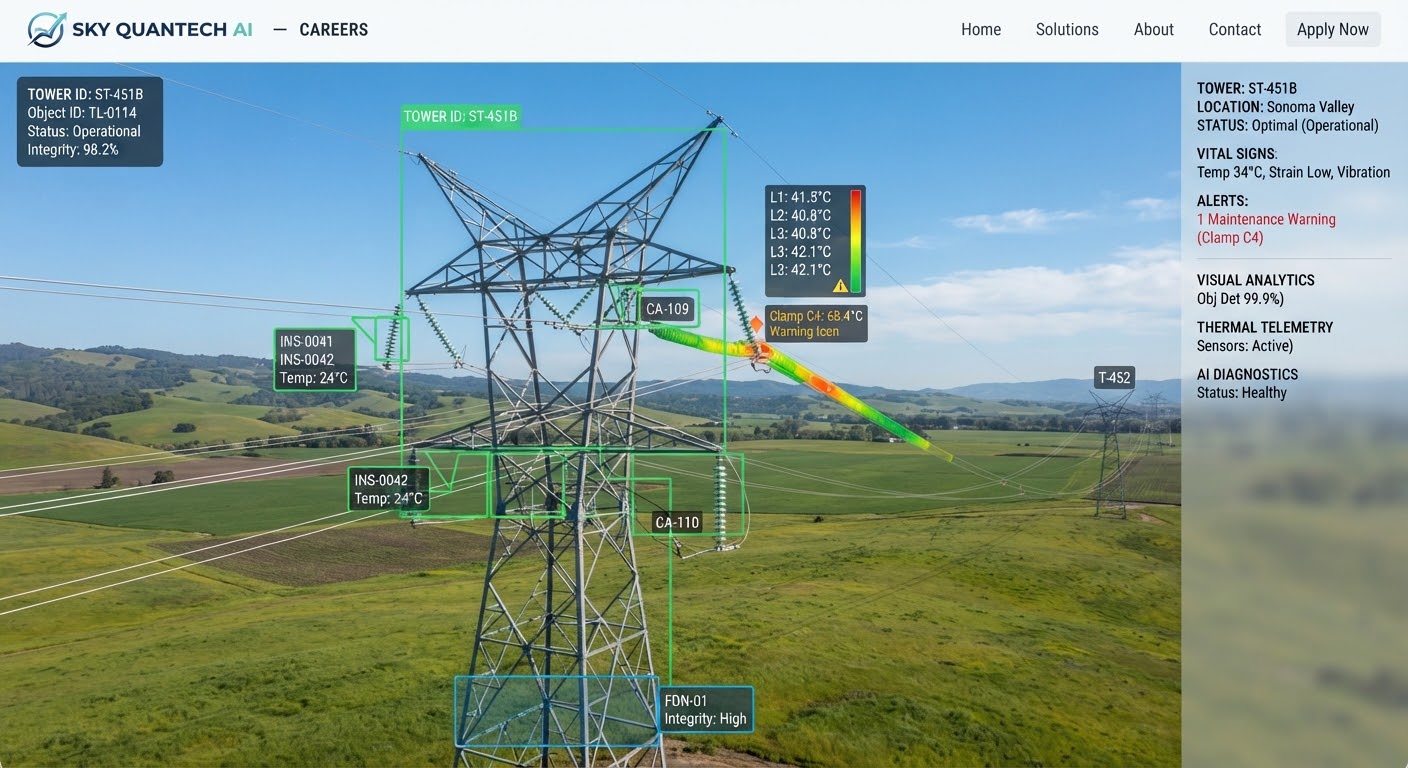
Drones can capture high-resolution imagery of power transmission towers and their components, allowing computer vision to assist with visual inspection.
The Challenge
Remote & Inaccessible Terrain
Power transmission infrastructure covers large and difficult-to-access environments. Drone-based imagery can provide a practical way to capture visual information for inspection and analysis.
Intended to support field teams with pre-screened imagery, not to replace on-site inspection.
Execution stages
Technology Workflow
- 01 · Ingest
Tower Imagery Capture
Drone image capture of transmission towers and their components.
- 02 · Parse
Component Analysis
Classification across lattice framework and line hardware.
- 03 · Infer
AI / Computer Vision
Flagging potential surface anomalies and wear traces.
- 04 · Assemble
Inspection Evidence
Audit-ready visual log indexed by tower ID and coordinates.
Visual taxonomy
Target Hardware Components
Tower Structure
Lattice steel cross-bracing, legs, and foundation gussets.
Insulators
Cap-and-pin glass, porcelain disks, and composite strings.
Conductors
Phase bundle strands, optical ground wire (OPGW), and jumpers.
Clamps
Suspension clamps, tension strain assemblies, and spacers.
Hardware
Shackles, cotter pins, damper weights, and corona rings.
Architectural convergence
One AI Foundation. Different Inspection Environments.
The environment changes. The technology adapts to the inspection problem.
Railway OHE
Rolling Stock
Power Grid
Core computational engine
- Computer Vision
- Machine Learning
- Image Analysis
- Audit Workflows
End-to-end topology
Inspection Technology Ecosystem
Conceptual workflow architecture
- 01 · Sensor
Capture
Drone UAV, high-speed lineside camera.
- 02 · Payload
Image
RGB and thermal imagery.
- 03 · Core
AI
Computer vision, deep learning models.
- 04 · Inference
Analysis
Component detection, visual analysis.
- 05 · Triage
Finding
Contextualized inspection finding.
- 06 · Provenance
Report
Structured, location-bound inspection evidence.
Start the conversation
Have an inspection challenge?
Tell us about your assets and workflows, and we'll explore a practical approach.